Complete OPT vs CPT Guide for F-1 Work Authorization
September 23, 2026 · 22 min read
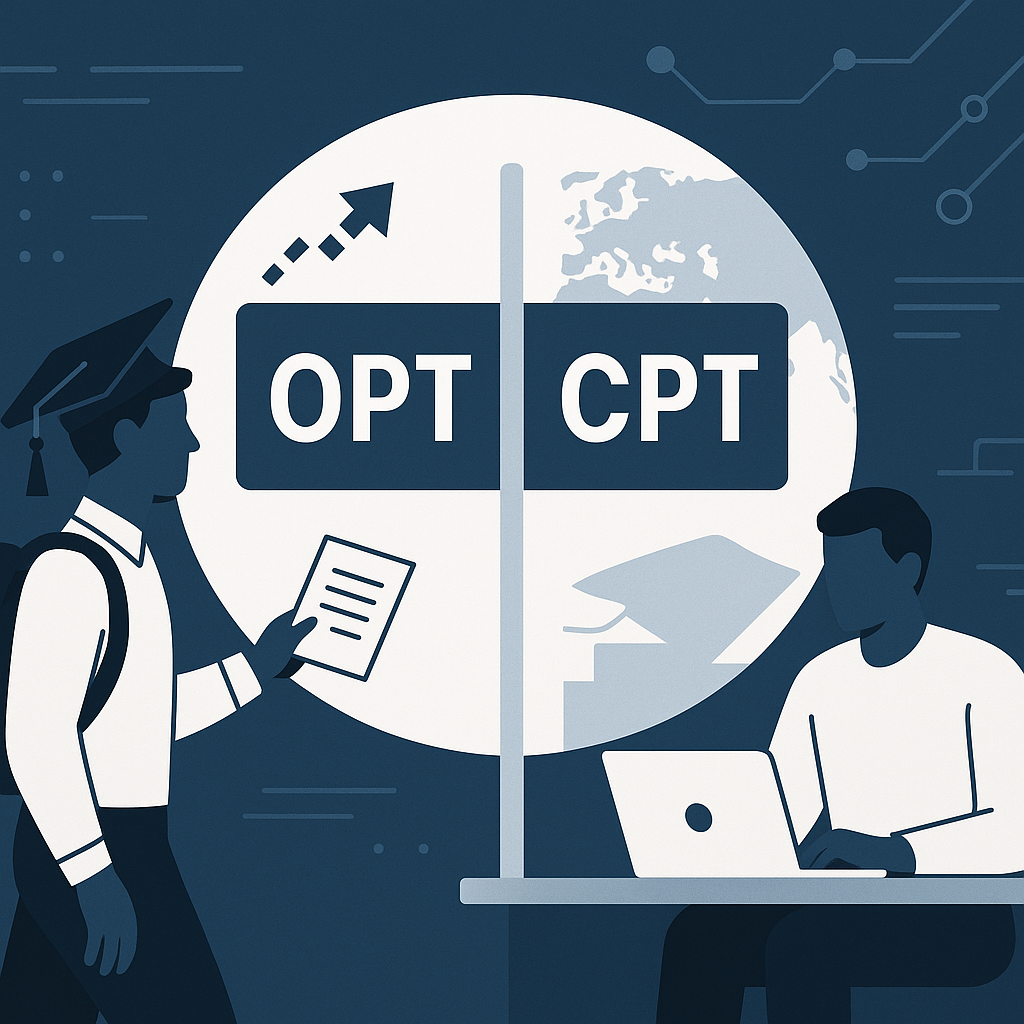
OPT vs CPT is one of the first work authorization decisions an F-1 student has to understand, because the wrong choice can cost you a job offer, delay graduation, or make you ineligible for future OPT. CPT is school-authorized training tied to your curriculum before program completion. OPT is USCIS-authorized work authorization that can be used before or after graduation, most often after graduation through an Employment Authorization Document.
The difference matters more in 2026 because SEVP issued new CPT guidance in August 2026 that many universities are applying narrowly. Students who previously expected an internship course to qualify for CPT may now be told their program does not meet the standard. OPT rules have stayed more stable, including the standard 12-month OPT period and the 24-month STEM OPT extension for eligible students.
Fast rule: CPT is for required, curriculum-based training during your degree. OPT is broader work authorization in your field of study, usually used after graduation. CPT is approved by your DSO in SEVIS. OPT requires an I-765 filing and an EAD from USCIS.
What will this guide compare?
- What is the quick OPT vs CPT comparison?
- How do OPT and CPT differ in legal purpose?
- Who is eligible for CPT or OPT?
- Who approves CPT and OPT?
- When can you work under each option?
- What changed for CPT in August 2026?
- How does STEM OPT change the comparison?
- Which choice fits common student scenarios?
- What mistakes can damage your F-1 record?
- How should you explain OPT and CPT to employers?
What is the quick OPT vs CPT comparison?
The simplest way to compare CPT and OPT is to ask four questions. Is the work part of your curriculum? Are you still enrolled? Do you need the authorization tied to one employer? Do you need USCIS to issue an EAD?
| Question | CPT | OPT |
|---|---|---|
| Primary use | Training required by, or integral to, the curriculum | Practical training directly related to the major |
| Typical timing | During the degree program | Before or after completion, most often after graduation |
| Who approves it | Designated School Official through SEVIS | USCIS through Form I-765 and EAD issuance |
| Job offer needed before approval | Yes, CPT is employer-specific | No for filing, but work must relate to the major after approval |
| Document proving work authorization | I-20 with CPT authorization on page 2 | EAD card for OPT |
| Employer-specific | Yes | No, if the work is in your field and meets OPT rules |
| Effect on future OPT | 12 months or more of full-time CPT removes OPT eligibility at that same education level | Pre-completion OPT is deducted from post-completion OPT |
| Best fit | Required internship, practicum, cooperative education, clinical placement | Post-graduation job search, full-time job, startup role, multiple qualifying employers |
ICE states that F-1 practical training includes CPT and OPT, and that the training must be directly related to the student’s major area of study ICE Practical Training guidance. That shared requirement often causes confusion. The difference is the source of authority. CPT comes from your school’s conclusion that the work belongs inside your academic program. OPT comes from USCIS granting time-limited employment authorization for practical training connected to your field.
If you need a step-by-step view of CPT paperwork, use Avisa’s CPT guide for F-1 students. If you are close to graduation and need the full OPT filing process, read the complete OPT guide after you understand the comparison here.
How do OPT and CPT differ in legal purpose?
CPT exists because some academic programs require real work experience as part of the curriculum. Common examples include a graduate data science program with a required practicum, a nursing or physical therapy clinical placement, a business analytics program with a required cooperative education term, or an education degree that requires supervised teaching. CPT should be traceable to the degree requirements, course catalog, department policy, or program structure.
OPT has a broader purpose. It gives an F-1 student a defined period of practical training related to the major area of study. The most common version is post-completion OPT, used after graduation for full-time employment. A student with a Master of Science in Computer Science might use OPT to work as a software engineer at Microsoft, Amazon, Datadog, or a venture-backed startup. A finance student might use OPT for an analyst role at JPMorgan Chase, BlackRock, or a fintech company, if the role connects to the degree.
The legal distinction creates a practical difference in employer conversations. For CPT, you need a specific offer before authorization, and your DSO must approve that employer, location, dates, and training relationship. For OPT, you can apply before having a job offer. Once the EAD is valid, you may work for qualifying employers in your field, subject to OPT reporting and unemployment rules.
For long-term planning, OPT often connects to H-1B timing. Many students use post-completion OPT to work while an employer tries the H-1B lottery. If that is your path, review how to time the OPT to H-1B transition before choosing a graduation date or OPT start date.
Who is eligible for CPT or OPT?
What are the shared F-1 requirements?
Both CPT and OPT require valid F-1 status and work related to the student’s major. You cannot use either authorization for a job simply because it pays well or because the employer is willing to hire international students. A computer science student working as a restaurant manager would face a weak relationship argument. A computer science student working on restaurant point-of-sale software as a backend engineer has a much stronger field-of-study link.
Both options also require careful timing. Unauthorized work is one of the fastest ways to damage an F-1 record. Starting a paid training role one day before the CPT start date on your I-20 is unauthorized employment. Starting an OPT job before the EAD start date is also unauthorized. The fact that the employer needed you urgently does not fix the violation.
Who qualifies for CPT?
Traditional CPT eligibility usually requires one full academic year in valid F-1 status before authorization. Graduate programs can allow earlier CPT if immediate practical training is required by the program. This is the foundation for some first-semester CPT programs, often called Day-1 CPT, but the label does not make a program compliant. The curriculum must support the authorization.
After the August 2026 SEVP messages, many schools are asking a tighter question. Is the training required and integral to the degree for the program as a whole? Stony Brook University summarized SEVP Broadcast Message 2608-01, issued August 12, 2026, as a reminder of DSO liability for CPT authorization, and Broadcast Message 2608-02, issued August 24, 2026, as guidance for DSOs regarding CPT Stony Brook University CPT guidance summary. USC’s Office of International Services told students that CPT must be required for all students in the program, including domestic and international students, and that optional internship courses would not be enough under the new guidance USC OIS CPT update.
Who qualifies for OPT?
OPT is available for eligible F-1 students at each higher education level. A student may use OPT after a bachelor’s degree, then later after a master’s degree, then later after a PhD, assuming the student meets the rules at each level. Post-completion OPT is normally 12 months. Pre-completion OPT can be used before graduation, but time used before completion reduces the post-completion amount available.
OPT does not require an employer to be part of the curriculum. A marketing student can apply for post-completion OPT before receiving a final offer. A robotics student can receive the EAD, then choose between a hardware engineering role and a robotics software role, as long as the work is directly related to the degree and properly reported.
Who approves CPT and OPT?
How CPT approval works
CPT is approved by the DSO at your school. There is no USCIS I-765 filing and no EAD. The authorization appears on the Form I-20, usually on page 2, with the employer name, work location, start date, end date, and whether the CPT is part-time or full-time. You may work only within those terms.
This means the DSO is making a compliance decision, not rubber-stamping an employer request. If your academic department cannot show that the internship is required and integral to the curriculum, the DSO may deny CPT even if the employer is a major company and the role clearly relates to your major. After the 2026 SEVP messages, schools have more reason to document why each CPT authorization qualifies.
Georgetown University told students with pending CPT requests as of August 24, 2026 that it was reviewing Fall 2026 CPT authorizations in light of the new SEVP guidance and working with academic programs to identify programs that satisfy degree-completion dependency Georgetown University immigration updates. Bryn Mawr College also announced that it was reviewing CPT policies and procedures after SEVP Broadcast Messages 2608-01 and 2608-02 Bryn Mawr College ISSA announcements.
How OPT approval works
OPT requires a DSO recommendation in SEVIS and a Form I-765 application to USCIS. The student cannot begin work until the EAD is approved, received, and valid for the date of employment. The DSO recommendation alone is not work authorization for OPT.
This approval structure creates different risk points. For CPT, the main risk is whether the program and job meet the school’s CPT standard before work starts. For OPT, the main risk is filing too early, filing too late, missing the required I-20 timing, or starting work before the EAD start date. Students planning OPT should track school deadlines, USCIS receipt timing, and the requested OPT start date. Avisa’s OPT application timeline and processing guide explains those filing windows in detail.
When can you work under CPT or OPT?
CPT timing during your degree
CPT usually happens while you are still completing your degree. It can be part-time or full-time. Part-time CPT is generally 20 hours per week or fewer. Full-time CPT is more than 20 hours per week. Your school may set stricter academic limits, especially during the fall or spring term.
The biggest timing consequence is the 12-month full-time CPT rule. If you use 12 months or more of full-time CPT, you lose eligibility for OPT at that same education level. Part-time CPT does not trigger that same loss. For example, a master’s student who uses full-time CPT from June through August for one summer internship usually preserves OPT. A student who works full-time CPT for 13 months in a program may lose post-completion OPT for that degree level.
Students sometimes ask whether they can use CPT as a bridge after finishing degree requirements. CPT is tied to the curriculum during the program. If you have completed all degree requirements, post-completion OPT is usually the correct category for work after completion. Ask your DSO before assuming that enrollment in a final administrative course keeps CPT available.
OPT timing before and after completion
OPT can be pre-completion or post-completion. Pre-completion OPT is used before finishing the program. During school sessions, pre-completion OPT is limited to part-time work. During annual vacation or after completing coursework while a thesis remains, it may be full-time if the student meets the rules. Post-completion OPT is the common path after graduation and can support full-time work.
Post-completion OPT has a 90-day unemployment limit. USC’s STEM OPT page confirms that regular post-completion OPT permits 90 days of unemployment, while the STEM OPT period allows a total of 150 days across regular OPT and STEM OPT combined USC OIS STEM OPT extension guidance. Students should count unemployment days from the EAD start date, not from graduation, and should report employment through the required school or SEVP process.
If you need to work before graduation for a required internship, CPT is often the practical choice. If you need to work after graduation, post-completion OPT is usually the main path. If you are deciding whether to graduate in May, August, or December, model your OPT start date around job market cycles, H-1B lottery timing, and employer onboarding schedules.
What changed for CPT in August 2026?
The regulation defining CPT did not receive a broad rewrite in August 2026. The enforcement interpretation became tighter through SEVP messages to schools. That distinction matters because students may hear that CPT was banned, or that every Day-1 CPT program is invalid. Those statements are too broad.
Stony Brook’s summary of SEVP Broadcast Message 2608-02 states that practical training must be required and integral to the degree program, and that elective internships or optional courses no longer suffice as the basis for CPT authorization Stony Brook University CPT guidance summary. USC’s update stated that all students in the program, domestic and international, must undertake the requirement for CPT to qualify under the guidance USC OIS CPT update.
Here is how that can play out in real cases.
- Required practicum in a graduate program: A Master of Social Work program requires supervised field placement for every student. CPT is likely easier to document because the work is built into degree completion.
- Optional internship elective: A Master of Business Analytics student wants to take an optional one-credit internship course to work at a consulting firm. After the 2026 guidance, many schools may reject that as a CPT basis.
- Capstone with required industry project: A data science program requires every student to complete an industry-based capstone. CPT may be possible if the employment matches the required structure and the school documents the connection.
- First-semester graduate CPT: A program that requires practical training from the first term may still support early CPT. A program that added an internship elective mainly to give F-1 students work authorization faces higher risk.
Before accepting an internship, ask your DSO for the school’s current CPT standard in writing. Ask your academic department whether the training is required for every student in the program. Ask whether the course catalog, degree audit, program handbook, or departmental policy proves that requirement. A verbal statement from a recruiter or professor is weak evidence if your record is reviewed later.
Does the 2026 fixed admission rule affect OPT or CPT?
For now, F-1 Duration of Status remains in place because a federal court blocked implementation of the fixed admission rule. DHS published a final rule on July 17, 2026 that would have removed Duration of Status for F-1 and J-1 students and replaced it with a fixed period of admission, with an intended effective date of September 15, 2026. Boston College reported that a preliminary injunction issued on September 14, 2026 blocked implementation nationwide, leaving the existing D/S system in effect as of that update Boston College OISS regulatory update.
This matters for OPT vs CPT planning because a fixed admission system could have created extra extension-of-stay issues for students whose I-94 end date did not cover OPT or STEM OPT. Since the rule is blocked, students should follow current D/S procedures unless their school announces a change based on future litigation.
Charlotte’s International Student and Scholar Office has warned that if a fixed period of admission system takes effect later, students traveling after the effective date could receive a new I-94 with an Admit Until Date and may need Form I-539 extension-of-stay planning in some OPT or STEM OPT cases Charlotte ISSO STEM OPT information. Treat that as a travel and status planning issue, not a reason to assume OPT or CPT disappeared.
How does STEM OPT change the OPT vs CPT decision?
STEM OPT can make post-completion OPT much more valuable for eligible students. The STEM OPT extension adds 24 months beyond the initial 12-month post-completion OPT period for qualifying STEM degrees, if the employer is enrolled in E-Verify and the student and employer complete the required Form I-983 training plan. USC’s 2026 guidance confirms the 24-month STEM OPT extension, the E-Verify employer requirement, the Form I-983 requirement, and the rule that STEM OPT employment must be at least 20 hours per week per employer USC OIS STEM OPT extension guidance.
A student with a qualifying STEM degree may have up to 36 months of OPT-related work authorization across initial post-completion OPT and STEM OPT. That longer runway can support multiple H-1B lottery attempts, career growth inside one company, and a stronger record for employer-sponsored green card planning. Students in non-STEM fields generally have only the standard 12 months of post-completion OPT, so preserving that OPT year can be even more valuable.
The STEM OPT filing window is also strict. The University of Utah states that students may submit a STEM OPT extension application no earlier than 90 days before the post-completion OPT end date and no later than the OPT end date University of Utah STEM OPT guidance. USC’s OIS lists a 10-business-day internal processing period for its STEM OPT I-20 recommendation USC OIS STEM OPT extension guidance. Your school may use a different internal deadline, so build in extra time.
Students in STEM fields should be careful with full-time CPT. One summer of full-time CPT usually will not hurt future OPT. A full year or more of full-time CPT can remove the 12-month OPT period at that education level, which also prevents the usual path into STEM OPT because STEM OPT requires current post-completion OPT. For a deeper extension checklist, use Avisa’s STEM OPT guide.
Which option fits common F-1 student scenarios?
Scenario 1, required summer internship before the final year
A master’s student in human-computer interaction has a required summer internship built into the degree plan. The student receives an offer from Adobe for a UX research internship from June 3 to August 16. The department confirms that the internship is required for all students in the program. CPT is the likely fit because the work occurs during the degree and is tied to a required curricular component.
The student should not start work until the CPT I-20 is issued with Adobe, the correct address, and the correct dates. If the internship becomes remote from a different state, the student should ask the DSO whether the CPT record must be updated before the location changes.
Scenario 2, optional internship course after August 2026
A finance student wants to work at a private equity firm during the fall semester and enroll in a one-credit internship elective. The degree does not require an internship, and domestic students can graduate without it. Under the stricter 2026 interpretation described by Stony Brook and USC, the DSO may refuse CPT. The student should not pressure the school or ask the employer to classify work as unpaid to avoid authorization. Unpaid work can still require authorization if it is training or productive work that would normally be paid.
The better plan may be to preserve post-completion OPT, adjust graduation timing, or find on-campus employment if eligible. If the student later uses OPT, the role must still connect to the finance degree.
Scenario 3, post-graduation software engineering role
A computer science student graduates in May and accepts a full-time software engineering role at Google starting in July. Post-completion OPT is the normal route. CPT is generally unavailable after degree completion because the work is no longer part of an active curriculum requirement. The student needs an approved EAD with a valid start date on or before the first day of work.
If the degree is STEM-designated and Google is an E-Verify employer for the hiring entity, the student may later seek the 24-month STEM OPT extension. The student should confirm the employer’s legal entity, E-Verify status, worksite, supervisor, and training plan support well before the initial OPT end date.
Scenario 4, graduate program advertising Day-1 CPT
A student whose H-1B was not selected considers enrolling in a graduate program that advertises work authorization from the first semester. Early CPT can exist when the academic program requires practical training immediately. Risk rises when the program appears designed mainly to keep students employed rather than to deliver a degree with a required training component.
Before enrolling, ask for the catalog language showing that practical training is required for all students. Ask how many in-person sessions are required, how attendance is tracked, how the job is evaluated academically, and whether CPT is available only to F-1 students or to all students in the program structure. Keep copies of admissions materials, curriculum requirements, CPT approvals, and employer training documents.
What mistakes can damage your F-1 record?
Starting before authorization is the most serious and most preventable error. For CPT, the authorization must appear on your I-20 before the work begins. For OPT, the EAD must be approved and valid. A signed offer letter is not work authorization. A pending I-765 is not work authorization for initial post-completion OPT.
Using CPT for a job that is not curricular is now a higher-risk choice after the 2026 SEVP messages. If your school denies CPT, do not seek a different department employee to approve it informally. CPT must be entered properly in SEVIS by the DSO. If a school approves questionable CPT, the student can still face problems later during visa stamping, change of status, H-1B filing, or green card processing.
Forgetting the full-time CPT limit can remove OPT eligibility. Track every full-time CPT day. If your program includes multiple co-op terms, ask the DSO to calculate your cumulative full-time CPT before you accept another term. Do not assume that changing employers resets the clock.
Missing OPT reporting duties can create status issues even after the EAD is approved. Post-completion OPT has a 90-day unemployment cap. STEM OPT has a 150-day total unemployment cap across initial OPT and STEM OPT, as USC’s guidance states USC OIS STEM OPT extension guidance. Keep offer letters, job descriptions, pay records, supervisor details, and proof that the work relates to your major.
Relying on fee rumors can lead to filing mistakes. USCIS announced FY 2026 inflation increases for certain immigration-related fees, including a listed I-765 increase from $550 to $560 for certain EAD categories, but that notice did not state that every OPT or STEM OPT student filing category changed by that amount USCIS FY 2026 fee increase announcement. Always check the current USCIS fee page and your school’s OPT instructions on the day you prepare the filing.
How should you explain OPT and CPT to employers?
Employers often misunderstand F-1 work authorization. Some recruiters think every international student needs H-1B sponsorship immediately. Others think CPT and OPT are interchangeable. A clear explanation can save an interview process.
For CPT, use language that shows the employer you need school authorization before the start date. You might say, “I am eligible to work through Curricular Practical Training if my university approves this role as part of my required degree training. The authorization is employer-specific, so I will need the offer letter with job title, dates, location, hours, and supervisor information before I can start.”
For OPT, use language that separates current work authorization from future sponsorship. You might say, “I am eligible for post-completion OPT after graduation, which provides U.S. work authorization in my field. I will need my EAD before starting. If hired, I can work during the authorized OPT period, and we can discuss H-1B sponsorship timing based on company policy.”
For STEM OPT, be direct about E-Verify and the training plan. You might say, “Because my degree is STEM-designated, I may qualify for a 24-month STEM OPT extension after my first year of OPT. The employer must be enrolled in E-Verify, and we would complete a Form I-983 training plan.” This helps recruiters identify whether the company can support the extension before you reach the final interview.
Avisa helps international students focus on employers that have a history of hiring visa-dependent talent. That matters because a company familiar with OPT, STEM OPT, and H-1B timing is less likely to withdraw an offer because a recruiter misunderstood the process.
What documents should you keep for CPT and OPT?
Keep your own immigration and employment file. Do not rely on a school portal or employer HR system to keep records forever. You may need documents years later for H-1B, consular visa stamping, permanent residence, or a USCIS request for evidence.
For CPT, save the offer letter, CPT I-20, course registration proof, syllabus or practicum description, degree requirement language, pay records, supervisor name, work location, and any DSO emails confirming authorization. If the CPT was required for all students in your program, keep the catalog page or handbook section showing that requirement.
For OPT, save the I-20 with OPT recommendation, I-765 receipt, approval notice if available, EAD front and back, job offer letters, job descriptions, pay records, employer addresses, reporting confirmations, and a short memo explaining how each job related to your major. For STEM OPT, add the signed Form I-983, evaluations, E-Verify confirmation if provided by the employer, and any material-change updates.
Good records make future filings easier. For example, an H-1B petition may ask for proof that you maintained F-1 status. A visa officer may ask what you did on CPT. A green card process may require a full employment history. Your documents should answer those questions without relying on memory.
How should you choose between OPT and CPT?
Use this decision framework before accepting any role.
- Identify the timing. If the work is before completion and part of the degree, CPT may fit. If the work is after completion, OPT is usually the correct path.
- Test the curriculum link. Ask whether the training is required and integral to the program, especially after the August 2026 SEVP guidance. Optional internship courses are weaker after the new messages.
- Check the approval path. CPT needs DSO authorization on the I-20. OPT needs USCIS approval and an EAD.
- Calculate future OPT value. Avoid 12 months or more of full-time CPT unless you fully understand the loss of OPT at that education level.
- Confirm employer details. CPT requires employer-specific information before approval. STEM OPT requires E-Verify and a training plan.
- Build in school processing time. Some schools require many business days for CPT or STEM OPT I-20 review. USC lists 10 business days for its STEM OPT I-20 recommendation process USC OIS STEM OPT extension guidance.
- Keep proof. Save every I-20, EAD, offer letter, training plan, and reporting confirmation.
Students who treat CPT as an academic authorization and OPT as post-completion work authorization usually avoid the biggest mistakes. CPT should match the curriculum. OPT should match the major. Both require approval before work begins.
If you are job searching now, filter for employers that understand F-1 hiring, ask about CPT or OPT support early, and keep your DSO involved before you commit to a start date. The safest offer is one you can start legally, document clearly, and connect to your long-term U.S. work plan.
Sources
This guide draws on the following official and institutional sources. Immigration rules change often — check the original source for the current position before acting on it.
- Practical Training | ICE (ice.gov)
- Updated SEVP Guidance on Curricular Practical Training (CPT) (stonybrook.edu)
- Important Update About CPT Requirements | USC OIS (ois.usc.edu)
- bc.edu (bc.edu)
- STEM OPT Extension - USC OIS (ois.usc.edu)
- 24 Month STEM Optional Practical Training (OPT) Extension - International Student & Scholar Services - The University of Utah (isss.utah.edu)