L-1 vs H-1B Visa Complete Transfer Guide 2026
September 29, 2026 · 22 min read
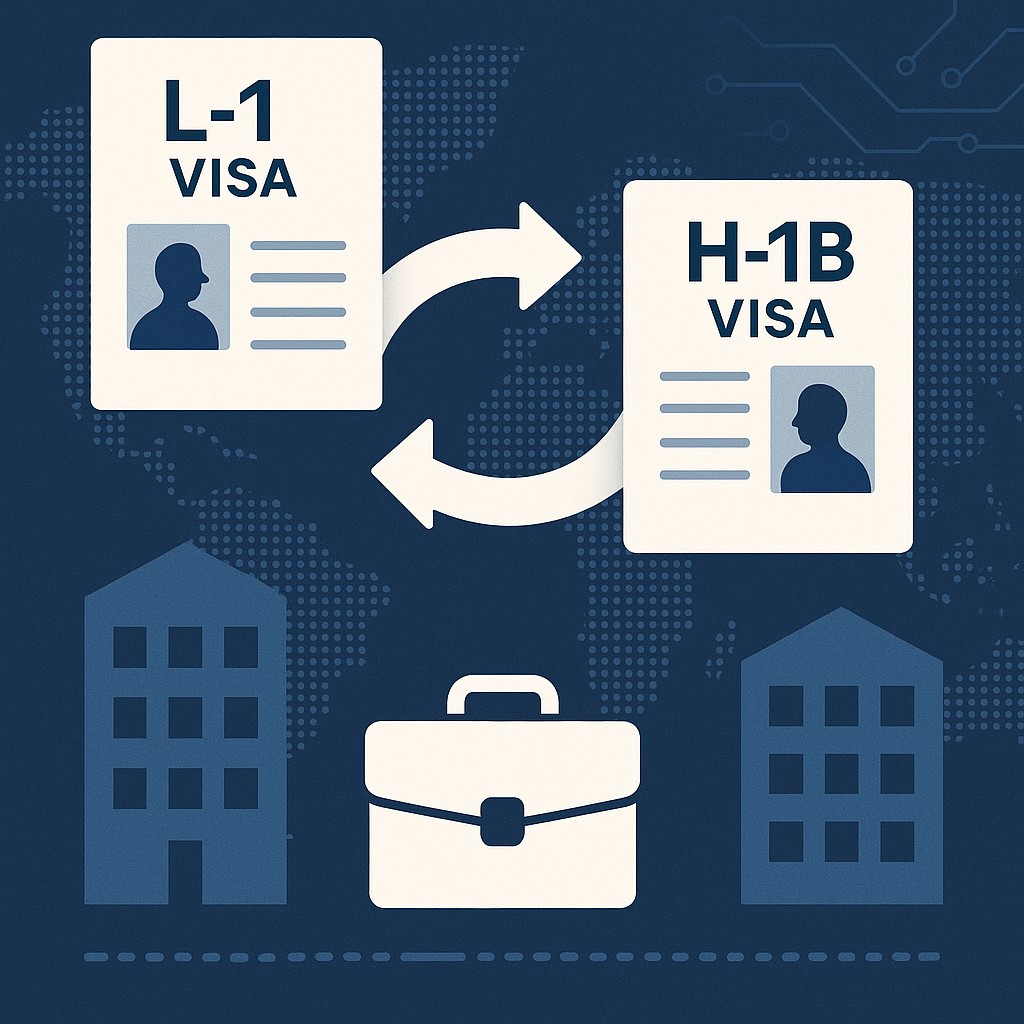
L-1 visa vs H-1B is usually a company transfer decision before it is an immigration preference decision. If you already work for a multinational employer outside the United States, the L-1 can avoid the H-1B cap, registration system, Labor Condition Application, and prevailing wage rules. If you need wider employer mobility or do not meet the one-year foreign employment rule, the H-1B may fit better, provided the employer can handle the cap process or qualifies for a cap-exempt filing.
For intra-company transfers, the practical answer is often clear: use L-1A for executives and managers, consider L-1B for workers with provable company-specific knowledge, and use H-1B when the role is a specialty occupation but the worker does not fit L-1 rules. The hard cases involve senior engineers, product managers, consultants, founders, and employees moving from a foreign affiliate to a U.S. client-facing role.
Fast rule of thumb: L-1 is usually better for a true multinational transfer. H-1B is usually better for long-term job mobility across U.S. employers. The green card, spouse work authorization, wage rules, and transfer risk can change the answer.
Table of contents
- What is the fastest way to compare L-1 and H-1B?
- Who qualifies for L-1 or H-1B in a transfer?
- How do caps and selection rules affect timing?
- How do wage rules and costs compare?
- How long can you stay in the United States?
- Which visa is better for a spouse who wants to work?
- Which visa is better for the green card process?
- What happens if you change jobs or get laid off?
- Which visa fits common transfer scenarios?
- Which misconceptions cause bad visa choices?
- How should employers choose between L-1 and H-1B?
What is the fastest way to compare L-1 and H-1B?
The L-1 visa is built for transfers from a foreign company to a related U.S. company. The H-1B is built for U.S. specialty occupation employment. Those goals overlap when a multinational employer wants to move an employee from Bangalore, Toronto, London, São Paulo, Singapore, or Berlin into a U.S. office.
The L-1 usually wins on timing because there is no annual numerical cap. USCIS adjudicates the petition when filed. The H-1B has a 65,000 regular cap and a 20,000 U.S. advanced degree exemption, and USCIS reached both FY 2026 caps, as AILA reported in its USCIS Reaches Fiscal Year 2026 H-1B Cap notice. That cap reality matters for a transfer that must happen in May, July, or November, since a cap-subject H-1B may not be available on the company’s business schedule.
The H-1B can win on career flexibility. An H-1B worker can move to another H-1B employer through portability after a new employer files a petition, subject to the rules explained in Avisa’s guide to changing employers on H-1B. An L-1 worker is tied to the qualifying organization and its related entities. If the worker wants to leave the multinational group, the L-1 does not travel with them to an unrelated startup, bank, hospital, or consulting firm.
| Issue | L-1 for intra-company transfers | H-1B for transferred employees |
|---|---|---|
| Best fit | Managers, executives, and employees with specialized knowledge moving inside a corporate group | Specialty occupation workers sponsored by a U.S. employer |
| Foreign employment requirement | One continuous year abroad for a qualifying organization within the last three years | No foreign affiliate employment requirement |
| Annual cap | No annual cap | 65,000 regular cap plus 20,000 U.S. master’s cap for cap-subject employers |
| Selection process | No lottery or weighted registration | Weighted selection for cap-subject registrations effective February 27, 2026 |
| Wage floor | No H-1B-style prevailing wage system | Employer must pay the higher of actual wage or prevailing wage |
| Maximum stay | L-1A up to 7 years, L-1B up to 5 years | Usually up to 6 years, with AC21 extensions in green card cases |
| Spouse work | L-2 spouses are employment authorized | H-4 spouse work depends on H-4 EAD eligibility |
| Green card path | L-1A often pairs well with EB-1C multinational manager or executive cases | Commonly pairs with PERM-based EB-2 or EB-3 cases |
Who qualifies for L-1 or H-1B in a transfer?
What does the L-1 require?
The L-1 has a strict corporate relationship test and a strict work history test. The employee must have worked abroad for a qualifying organization for one continuous year during the three years before admission to the United States. The U.S. and foreign entities must have a qualifying relationship, such as parent, branch, affiliate, or subsidiary. USCIS describes the evidence framework for L-1 petitions in USCIS Policy Manual, Volume 2, Part L, Chapter 8.
The job must also fit one of the L-1 classifications. L-1A is for executives and managers. L-1B is for specialized knowledge employees. A director who manages a product engineering organization across regions may fit L-1A. A senior implementation engineer who knows a proprietary payments platform, internal architecture, customer deployment method, and undocumented escalation process may fit L-1B if the company can prove the knowledge is special inside the business and relevant to the U.S. role.
L-1B is where many transfer cases fail. A strong engineer with common Java, Python, React, AWS, SAP, Salesforce, or data engineering skills does not qualify only because the worker is talented. The employer must show knowledge of the company’s product, process, research, equipment, management, or other interests that is uncommon in the labor market or advanced within the organization. Internal training records, architecture documents, patent records, product release history, customer escalation logs, and letters from technical leaders can matter more than a generic job description.
What does the H-1B require?
The H-1B requires a specialty occupation role and a worker who meets the position’s degree or equivalent requirement. The employer must file a Labor Condition Application and promise to pay the required wage. The worker does not need prior foreign employment with the company. A newly hired software engineer, data scientist, finance analyst, mechanical engineer, UX researcher, or clinical data manager can qualify if the role and credentials meet the H-1B standard.
For transfer planning, this difference is decisive. A multinational company can use H-1B for a person hired from the open market or for an employee who has worked abroad for only six months. L-1 is unavailable until the one-year foreign employment requirement is met. If a company wants to hire a Canadian product manager in Toronto today and move her to Seattle in four months, L-1 timing may fail unless she already has one qualifying year with the foreign entity.
For background on the H-1B classification itself, Avisa’s complete beginner’s guide to the H-1B visa covers specialty occupations, employer sponsorship, and cap concepts. This guide focuses on the transfer decision inside multinational groups.
How do caps and selection rules affect timing?
The L-1 has no annual cap. That makes it the cleaner route for transfers tied to a product launch, plant opening, U.S. customer escalation, leadership rotation, or post-acquisition integration. A German automotive supplier moving a plant operations manager to South Carolina in August does not need to wait for the next H-1B registration cycle if the manager fits L-1A and has the required year abroad.
The H-1B cap can be a deal breaker for a cap-subject employer. The statutory numbers are 65,000 regular cap slots plus 20,000 U.S. master’s cap slots. For FY 2026, USCIS reached both caps. A cap-subject employer that misses selection cannot simply file a regular H-1B petition for an October start unless another cap exemption or previous cap count applies.
The selection system also changed. DHS published the Weighted Selection Process for Registrants and Petitioners Seeking To File Cap-Subject H-1B Petitions on December 29, 2025, with an effective date of February 27, 2026. The rule replaced pure random selection with a weighted system that gives greater selection chances to registrations for higher paid and higher skilled workers.
That change affects transfer strategy. A senior machine learning engineer offered $210,000 in San Jose may have a stronger H-1B registration profile under the weighted system than an entry-level analyst offered $72,000 in Dallas. The employer must also keep the registration details consistent with the petition. The SOC code, wage, location, and role cannot be treated as placeholders. A registration built on one wage level and a later petition filed for a materially different role can create denial risk.
Avisa’s H-1B lottery process guide explains cap selection mechanics in more detail. For transfer planning, the key point is narrower: L-1 timing is controlled mainly by eligibility and evidence, while cap-subject H-1B timing is controlled by the registration calendar, selection odds, wage strategy, and petition consistency.
How do wage rules and costs compare?
Does the L-1 have a prevailing wage requirement?
The L-1 does not use the H-1B prevailing wage system. There is no Labor Condition Application and no requirement to pay the higher of the actual wage or the prevailing wage. The employer still needs credible compensation evidence. USCIS may question whether the U.S. job is real, whether the business can support the role, and whether the offered salary matches the claimed seniority. A claimed executive role paid far below market can weaken the case because the pay may conflict with the job description.
This difference helps employers transferring leaders from countries where compensation bands are far lower than U.S. bands. A manager paid the local equivalent of $85,000 in India may move into a U.S. role at $135,000 on L-1A without a formal LCA calculation. On H-1B, the employer must check the required wage for the specific SOC code and worksite and pay at least the required amount.
How does the H-1B wage system affect transfers?
The H-1B wage rules are more rigid. The Department of Labor’s H-1B Advisor states that an H-1B employer must pay the required wage, which is the higher of the actual wage paid to similarly employed workers or the prevailing wage for the occupation and area of employment, as explained by the DOL H-1B Advisor. This can raise the cost of moving an employee to a high-wage U.S. city.
DOL issued a proposed rule on March 26, 2026 to revise prevailing wage methodology for H-1B, H-1B1, E-3, and PERM programs, according to the U.S. Department of Labor announcement. The proposal would use specific percentiles from the Bureau of Labor Statistics Occupational Employment and Wage Statistics survey. The public inspection version lists wage level percentiles such as 34th, 52nd, 70th, and 88th in the March 2026 proposed prevailing wage rule. Since this is proposed, employers should treat it as planning risk rather than current law.
For employers comparing L-1B and H-1B for a senior engineer, wage rules can change the cost calculation. A role in New York, San Francisco, Seattle, Boston, or Austin may have a prevailing wage that exceeds the company’s original transfer package. Avisa’s guide to H-1B wage levels and prevailing wage explains how DOL wage levels shape salary floors.
What are the government cost differences?
Both categories use Form I-129 for many filings, and both can use premium processing. The research point that matters for budgets is that premium processing is category-neutral for these purposes. Premium processing for I-129 cases, including H-1B and L-1, rose to $2,965 on March 1, 2026. Employers should verify the current fee on USCIS fee pages before filing because USCIS fee schedules can change.
A September 10, 2026 proposed rule would add an additional $103,265 fee for cap-subject H-1B nonimmigrant petitions, as described in the Fee for Certain H-1B Petitions proposed rule. The proposal is not in effect. If finalized in similar form, it would strongly favor L-1 for eligible intra-company transfers and push employers to reserve H-1B filings for cases where no L-1 route exists.
For a normal transfer, budget also includes attorney fees, fraud prevention fees where applicable, internal HR time, translations, corporate documents, and relocation. The bigger difference is indirect cost. H-1B may require wage increases, cap planning, and registration risk. L-1 may require heavy evidence preparation, especially for L-1B specialized knowledge or new office filings.
How long can you stay in the United States?
L-1A and L-1B have different maximum stays. L-1A managers and executives can stay for up to 7 years. L-1B specialized knowledge workers can stay for up to 5 years. H-1B workers commonly receive up to 3 years initially and can extend up to 6 years, with additional extensions available in certain green card cases under AC21 rules.
For a two-year U.S. assignment, either visa may work if the worker qualifies. For a long-term U.S. leadership move, L-1A can be stronger because it provides one more year than the ordinary H-1B limit and may align with EB-1C green card planning. For a specialized knowledge engineer with no near-term green card process, H-1B can provide a longer ordinary runway than L-1B because H-1B has a 6-year limit while L-1B has a 5-year limit.
New office cases require special caution. USCIS confirms that L-1 new office petitions receive initial approval for up to 1 year, and extensions, if granted, may be for up to 2 additional years under the evidence rules in USCIS Policy Manual Chapter 8 on L-1 documentation and evidence. A new office approval is not a 7-year pass for a founder, country manager, or launch team member. The company must prove U.S. business growth, staffing, premises, revenue or funding, and the continuing need for the executive, managerial, or specialized knowledge role.
H-1B extension planning has its own traps. Workers nearing the 6-year mark may need a PERM labor certification or immigrant petition strategy started early enough to support extensions beyond six years. Avisa covers these rules in H-1B extensions and the 6-year limit. Transfer employees should ask for a green card timeline before accepting a U.S. move that consumes their remaining H-1B time.
Which visa is better for a spouse who wants to work?
L-1 often has a major family advantage. L-2 spouses are employment authorized. That can be decisive for a two-income household moving to the United States, especially in cities where rent, childcare, health insurance, and relocation costs are high. A spouse who is a software engineer, finance professional, designer, nurse, academic researcher, or entrepreneur can preserve career momentum more easily under L-2 work authorization than under many H-4 scenarios.
H-4 spouses do not automatically receive open work authorization in every H-1B case. H-4 EAD eligibility depends on green card process milestones for the H-1B principal, such as an approved I-140 or certain AC21 extension situations. A family moving on H-1B may have a period where the spouse cannot work unless they hold a separate work-authorized status.
For an employee choosing between a London-to-New York L-1A transfer and an H-1B filing, the spouse issue can outweigh a small salary difference. If the spouse earns $120,000 in their own field and L-2 allows work sooner, the household economics may favor L-1 even if H-1B would give broader future job mobility. For details on H-4 work eligibility, see Avisa’s H-4 EAD work permit guide.
Which visa is better for the green card process?
Both L-1 and H-1B allow immigrant intent. A worker can hold either status while an employer starts a green card case. The better option depends on the worker’s role, credentials, country of chargeability, and employer plan.
L-1A can pair well with the EB-1C multinational manager or executive category. EB-1C can avoid PERM labor certification if the worker and company meet the requirements. That is a major advantage for true managers and executives because PERM can take a long time, requires recruitment, and is sensitive to layoffs, minimum requirements, worksite changes, and job description changes. A vice president transferred from a Singapore affiliate to lead a U.S. product division may be a stronger EB-1C candidate than a PERM candidate.
L-1B does not carry the same direct managerial green card advantage. Many L-1B workers still use PERM-based EB-2 or EB-3 paths, similar to H-1B workers. A specialized knowledge engineer from Brazil or Poland may move on L-1B but still need PERM if the employer wants permanent residence. If that worker is from India or China, visa bulletin backlogs may make long-term status planning more complex.
H-1B is a familiar green card bridge because AC21 rules can allow H-1B extensions beyond six years when the green card process reaches certain points. That can make H-1B safer for workers facing long immigrant visa backlogs. L-1 limits are harder. An L-1A worker who reaches 7 years or an L-1B worker who reaches 5 years may need to leave, recapture time, change status if eligible, or rely on a completed green card step before the maximum stay becomes a problem.
If the employer is deciding between L-1A and H-1B for a senior manager, ask whether the company is ready to assess EB-1C within the first year after transfer. If the answer is yes, L-1A may be the stronger long-term route. If the worker is an individual contributor with PERM as the likely path, compare H-1B time, L-1B limits, country backlogs, and the company’s willingness to start PERM quickly. Avisa’s guide to the PERM labor certification process is useful for workers whose green card plan depends on EB-2 or EB-3 sponsorship.
What happens if you change jobs or get laid off?
H-1B usually gives better mobility after the worker is in the United States. A new employer can file an H-1B change of employer petition, and the worker may begin employment after USCIS receives the petition if portability requirements are met. That matters for workers who want access to the broader U.S. labor market after arrival.
L-1 does not offer the same path to an unrelated employer. The worker is tied to the qualifying multinational group. A move from the U.S. subsidiary of Infosys, Siemens, Samsung, Amazon, Toyota, or Roche to an unrelated U.S. employer generally requires a new status, such as H-1B, O-1, TN for eligible Canadian or Mexican professionals, or another work-authorized category. If the worker has never been counted against the H-1B cap, the new employer may face cap timing and selection limits.
Layoffs are also different in practice. H-1B workers generally think in terms of the 60-day grace period or the end of the I-94 validity period, whichever is shorter. L-1 workers may also have grace period options, but finding a replacement sponsor is harder because an unrelated employer cannot simply file an L-1 transfer. A laid-off L-1 worker often needs a cap-subject H-1B, cap-exempt H-1B, O-1, dependent status, student status, or departure plan.
Employees accepting L-1 transfers should ask whether the company would support an H-1B cap registration later as a mobility and backup strategy. Some multinationals file H-1B registrations for L-1 employees after arrival so the worker can eventually move into H-1B status and gain more employer portability. This is especially useful for L-1B workers with a 5-year maximum stay.
Which visa fits common transfer scenarios?
Scenario 1: Senior manager moving from India to lead a U.S. team
A senior engineering manager has worked for the Indian subsidiary of a U.S. technology company for four years. She manages 28 engineers and owns the roadmap for an internal platform used by U.S. teams. The U.S. company wants her in California to manage two teams and report to a U.S. vice president.
Likely better option: L-1A, if the evidence shows real personnel management, budget authority, decision-making power, and a qualifying corporate relationship. The company avoids the H-1B cap and can assess EB-1C if the managerial facts remain strong after transfer.
Scenario 2: Software engineer with proprietary platform knowledge
A senior engineer in Poland built the internal billing engine for a SaaS company and has three years of experience with source code, deployment tools, incident response history, and customer migration scripts. The U.S. team needs him for an 18-month migration project.
Likely better option: L-1B may work if the company can prove specialized knowledge with concrete records. If the evidence is thin and the role looks like a standard backend engineering job, H-1B may be more predictable if cap selection is available or the employer is cap-exempt.
Scenario 3: New hire abroad with no one-year company history
A U.S. fintech company hires a data scientist in Canada and wants to move him to New York after three months. He has a master’s degree and the role requires advanced quantitative skills.
Likely better option: H-1B, assuming cap strategy works, because L-1 requires one continuous year of qualifying employment abroad. If the worker is Canadian and the occupation fits, TN may also be worth checking, but that depends on the specific role and credentials.
Scenario 4: Founder opening a U.S. office
A founder owns a foreign company and wants to open a U.S. office to hire sales and support staff. The business has customers, revenue, and funding, but the U.S. entity is new.
Likely better option: L-1A new office can be a strong route if the corporate structure, business plan, U.S. premises, financial ability, and staffing plan are credible. The first approval is up to 1 year, so the company must be ready to prove real U.S. operations at extension. H-1B for founders can be possible in some cases, but employer-employee control and cap timing must be handled carefully.
Scenario 5: Consultant moving to serve U.S. clients
A consulting firm wants to move a senior consultant from Brazil to the United States for client delivery. The consultant knows the firm’s methodology, but much of the work will happen at third-party client sites.
Likely better option: Case-specific. L-1B may face scrutiny if the specialized knowledge claim is mostly general consulting skill. H-1B may fit if the specialty occupation, end-client work, wage, and worksite details are well documented. The employer should compare the L-1 evidence burden against H-1B wage and cap risk.
Which misconceptions cause bad visa choices?
Misconception 1: L-1 always beats H-1B for transfers
L-1 is often better for a true intra-company move, but it is not automatic. A worker who lacks one year abroad, works for an entity without a qualifying relationship, or holds ordinary skills that cannot support L-1B may have a weak L-1 case. Filing a weak L-1B to avoid the H-1B cap can lead to a Request for Evidence or denial, then leave the company with no timely backup.
Misconception 2: H-1B is still a pure lottery
For cap-subject cases, the pure random model changed. DHS’s December 29, 2025 final rule created a weighted selection process effective February 27, 2026. Employers now need to treat wage level, SOC code, location, and role design as part of H-1B selection planning, not as details saved for the petition stage.
Misconception 3: New office L-1 gives a full multi-year runway at the start
A new office L-1 approval is limited at the start. USCIS policy confirms initial approval of up to 1 year. Extension requires proof that the U.S. office is active and can support the claimed role. A founder or country manager who spends the first year doing mostly sales calls, bookkeeping, and individual contributor work may struggle to prove an executive or managerial role at extension.
Misconception 4: H-1B wages are a paperwork issue only
Wage rules affect budget, offer design, selection weight, compliance, and green card planning. DOL reported 76,164 applications received in FY 2026 Q1 for H-1B, H-1B1, and E-3 LCAs, down 23.1 percent from the same period in FY 2025, in its FY 2026 Q1 LCA selected statistics report. Employers that file fewer LCAs may still face higher scrutiny on role classification and wage support, especially if proposed wage methodology changes advance.
Misconception 5: L-1 avoids all salary questions
L-1 avoids the LCA and prevailing wage system, but salary still matters as evidence. A U.S. director role paid like a junior analyst can damage the credibility of the petition. Compensation should match the company’s org chart, job duties, seniority, and U.S. business plan.
How should employers choose between L-1 and H-1B?
Use a structured review before filing. The right visa should match the facts already in the company’s records, not a job description rewritten after the decision.
- Confirm the corporate relationship. L-1 requires a qualifying relationship between the foreign and U.S. entities. Collect ownership charts, annual reports, formation documents, share records, and intercompany agreements.
- Check the worker’s foreign employment history. Confirm one continuous year abroad within the last three years. Review payroll records, tax documents, HR letters, travel history, and remote work periods.
- Classify the role honestly. L-1A needs executive or managerial duties. L-1B needs specialized knowledge. H-1B needs a specialty occupation and a qualified worker.
- Map the business deadline. If the transfer must happen outside the H-1B cap cycle, L-1 may be the only practical option if the worker qualifies.
- Calculate wage exposure. For H-1B, check actual wage, prevailing wage, location, SOC code, and any proposed wage rule risks. For L-1, confirm salary supports the claimed role.
- Plan for the spouse. L-2 work authorization can change the household decision. H-4 EAD may depend on later green card steps.
- Build the green card plan early. L-1A may support EB-1C. H-1B may support longer AC21 extension planning. L-1B needs careful timing if PERM backlogs are likely.
- Create a backup path. Consider H-1B registration for L-1 employees, O-1 for high-achieving workers, TN for eligible Canadian and Mexican professionals, or cap-exempt H-1B roles where available.
For employees, ask direct questions before accepting the transfer package. Which status will the company file? Who pays government and legal fees? Will premium processing be used? What is the green card start date? Will the company file an H-1B registration later if you enter on L-1? What happens if the U.S. role changes after arrival?
For employers, the strongest transfer filings start with documents that already exist: org charts, reporting lines, product records, payroll history, technical diagrams, board approvals, budgets, and customer evidence. A petition supported only by new letters and broad descriptions is weaker than a petition anchored in records created during normal business.
What is the better choice for an intra-company transfer?
Choose L-1A when the worker is a real manager or executive, has at least one qualifying year abroad, and the U.S. role will remain managerial or executive. It avoids the H-1B cap, can move faster, gives a 7-year maximum stay, and may support an EB-1C green card strategy.
Choose L-1B when the worker has documented company-specific knowledge that the U.S. business needs. It works best for proprietary platforms, internal products, confidential processes, specialized customer implementations, or knowledge that cannot be hired quickly from the U.S. labor market. Treat the 5-year limit and green card timing as early planning issues.
Choose H-1B when the worker does not meet L-1 requirements, needs wider future employer mobility, or holds a specialty occupation role with a strong wage and cap strategy. After the February 27, 2026 weighted selection rule, employers should design H-1B registrations with accurate wage, SOC code, location, and role details from the start.
If you are comparing offers or planning a transfer, search Avisa for employers that sponsor the visa category that fits your facts. Filter roles by visa type, employer sponsorship history, location, and seniority before you commit to a relocation timeline.
Sources
This guide draws on the following official and institutional sources. Immigration rules change often — check the original source for the current position before acting on it.
- U.S. Department of Homeland Security (uscis.gov)
- flag.dol.gov (flag.dol.gov)
- PSA: USCIS premium processing fees increased March 1 (reddit.com)